Halal Frozen Chicken from Brazil: SIF-Certified Supply Chain for Saudi Arabia Importers
June 25, 2026
Agricultural Spray Oil Market 2026: Why Brazil and Latin America Are Central to Global Supply
July 6, 2026

Arabica coffee futures on the New York ICE exchange fell to approximately $2.73 per pound in late June 2026 — a level not consistently seen since before the historic price rally of early 2025, when front-month contracts briefly surpassed $4.00/lb. For Gulf-region coffee importers and roasters who absorbed those elevated costs over the past 18 months, the current price environment represents a meaningful shift in the procurement landscape.
Brazil’s 2026/27 coffee harvest has reached just 39% of the planted area as of June 17, according to crop-monitoring firm Safras & Mercado — trailing the 43% completion rate recorded at the same point last year and slightly below the five-year average of 40%. At the same time, the partial closure of the Strait of Hormuz has pushed up shipping, insurance, and fuel costs across global commodity supply chains. Traders are also watching whether El Niño conditions this September and October could disrupt the critical flowering period for Brazil’s next crop cycle.
For procurement teams in Saudi Arabia, the UAE, Kuwait, and Oman — markets where Brazilian coffee underpins a significant share of commercial roasting volumes — the confluence of these signals demands a clear-eyed analysis: is this a genuine buying opportunity, or is it a temporary dip before another supply-driven correction?
What the Numbers Are Telling Us
The $2.73/lb level for NY arabica futures is significant in context. To understand why, it helps to trace where prices have come from. Between mid-2024 and early 2025, arabica futures staged one of the most dramatic rallies in recent memory, driven by a combination of factors: persistent drought in Brazil’s key growing regions of Minas Gerais and Espírito Santo, speculative fund positioning, and a global inventory drawdown that left certified warehouse stocks at multi-year lows. At the peak, front-month contracts exceeded $4.00/lb — a level that squeezed margins for importers, roasters, and hospitality operators across the Gulf Cooperation Council (GCC) and wider Middle East.
The retreat from those highs began in Q2 2025 and has been gradual but consistent. The current $2.73/lb represents roughly a 33–35% correction from peak levels. Technically, traders refer to this zone as a potential “value area” — meaning the price has returned to a range that more accurately reflects the long-term cost of production, logistics, and fair trader margin for Brazilian-origin arabica.
For buyers operating on 60–90 day procurement cycles, the implication is straightforward: fixing price today at sub-$2.75 insulates against the upside risks still present in this market — risks that, as the next section explains, are far from resolved.
Why Supply-Side Risks Have Not Disappeared
The harvest delay is the most immediate signal to watch. A 39% completion rate as of June 17 — against 43% a year earlier — may sound like a marginal difference, but in coffee the timing of the main harvest window matters enormously. Delays in strip-picking the ripe cherries can affect bean quality, processing throughput, and the availability of exportable lots in Q3 and Q4. Exporters running behind schedule on the harvest tend to prioritize their pre-contracted commitments, leaving spot and near-term buyers with less negotiating leverage.
Beyond the harvest pace, the El Niño concern looms large. Brazil’s arabica-producing states depend on reliable rainfall during September and October for the flowering of next year’s crop. Dry flowering periods can suppress cherry-set rates, directly impacting the 2027/28 production cycle. While this risk is still speculative — El Niño patterns are probabilistic, not certain — it adds a genuine medium-term premium to green coffee fundamentals that the current futures price does not fully reflect.
The Strait of Hormuz disruption adds another layer of complexity specific to Gulf buyers. Even when coffee is bought FOB Santos, the final cost landed at GCC ports incorporates freight and marine insurance rates that have risen materially in 2026. Buyers who factor in total landed cost — not just the FOB futures equivalent — will find that their actual per-kilo cost has not fallen as dramatically as the NY chart alone would suggest.
Taken together, these factors create a paradox: prices are low enough to be interesting, but the risk environment justifies moving sooner rather than waiting for a further dip that may not arrive.
What This Means for Gulf Coffee Importers
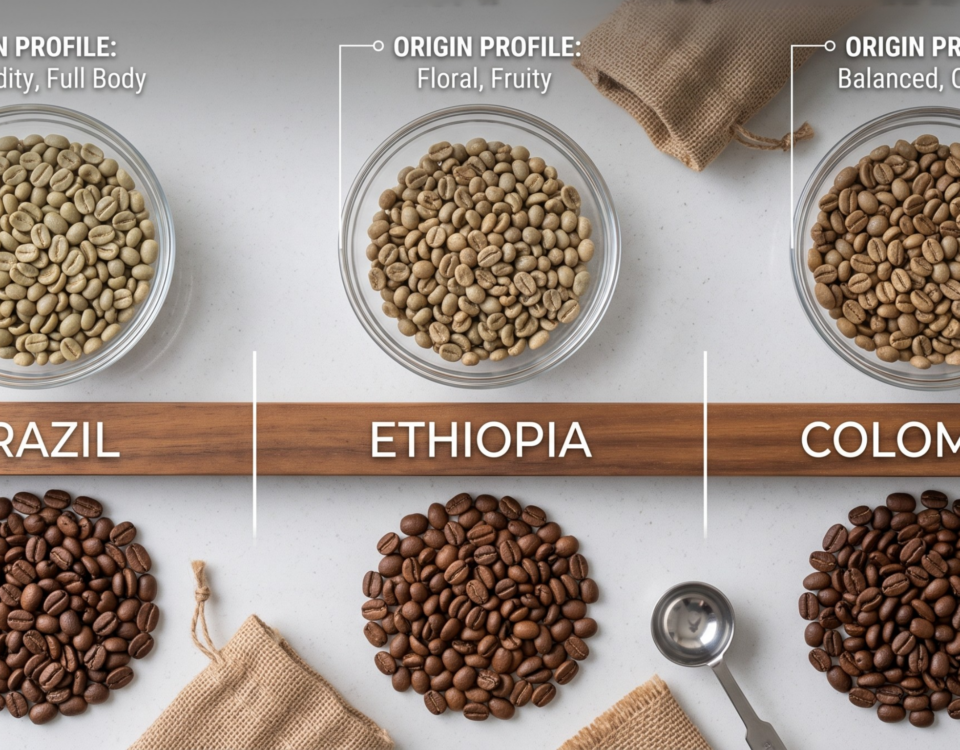
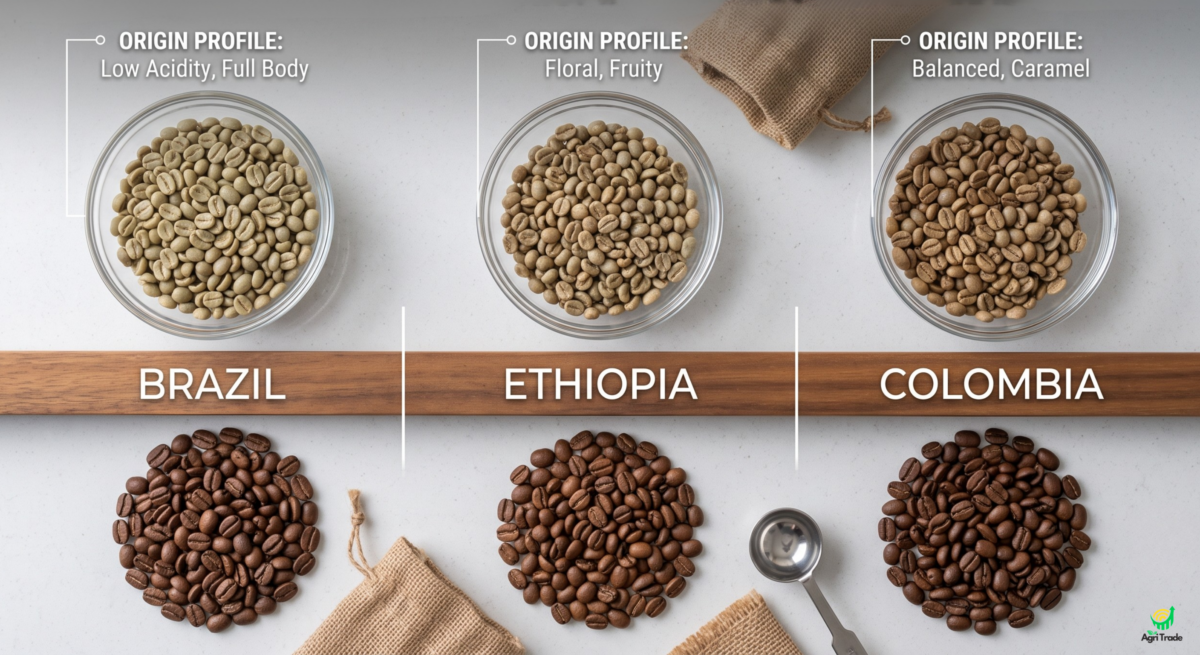
The GCC coffee market has matured significantly over the past decade. Saudi Arabia, the UAE, and Kuwait collectively represent one of the fastest-growing specialty and commercial coffee consumption regions in the world. The expansion of third-wave café culture in Riyadh and Dubai, combined with the continuing dominance of traditional Arabic coffee (qahwa) and blending demand from contract roasters, means that procurement teams in this region are managing increasingly complex sourcing requirements.
For those buyers, the current market configuration offers a specific window of opportunity — but one with conditions attached. Here is how the current data translates into practical procurement guidance:
Timing: Buying forward for Q4 2026 and Q1 2027 delivery at current futures levels creates a meaningful hedge against harvest-delay-driven price recovery. Waiting until Q3 to place orders risks encountering tighter supply and higher offers from Brazilian exporters who are already managing a behind-schedule crop.
Quality positioning: A harvest running slightly below five-year average completion rates can, in some years, correlate with better cup quality — slower, more selective picking tends to reduce the proportion of unripe or overripe cherries in the lot. Buyers with strict cupping specifications (84+ SCA score) may actually find this cycle favorable for sourcing premium naturals and pulped naturals from Minas Gerais.
Contract structure: In a market with elevated geopolitical uncertainty around the Strait of Hormuz, CIF contracts to Gulf ports — where the exporter absorbs freight and insurance risk — may offer more predictable landed costs than FOB-only structures. Buyers with the financial infrastructure to support Letters of Credit (LC) or Deferred LC terms are well positioned to negotiate CIF offers at competitive levels.
Volume strategy: Rather than committing to a full season’s volume in a single tranche, a phased approach — fixing 50–60% of anticipated volume now and leaving 40% open for Q3 — allows buyers to benefit from current prices while retaining flexibility if the market continues to soften.
Key Specifications: Brazilian Green Coffee (Arabica)
| Specification | Standard |
|---|---|
Conclusion
June 2026 presents an unusual alignment for Gulf coffee importers: arabica futures below $2.75/lb at precisely the moment when supply-side risks — a behind-schedule Brazilian harvest, El Niño uncertainty, and elevated logistics costs through the Strait of Hormuz — are building toward a potential recovery. History suggests that waiting for prices to fall further in this kind of environment is a higher-risk strategy than it appears. For procurement teams with Q4 2026 and 2027 demand to cover, acting now — even partially — converts a market risk into a commercial advantage.
Looking to Source Green Coffee from Brazil?
Market conditions for Brazilian arabica are shifting. If you have procurement needs for the next 60–90 days, AgriTrade Connect can provide specifications, certified lot availability, and a competitive offer with CIF pricing to Gulf, Asian, or African ports.
📧 gabriel.dias@agritradeconnect.com
Sources
| Source | Publication | Date | Link |
|---|---|---|---|