

Brazilian Halal Beef Exports 2026: ABIEC Data and What It Means for Gulf Importers
July 15, 2026
Brazilian Halal Chicken: Why the Gulf and Southeast Asia Depend on Brazil in 2026
August 10, 2026
Introduction
For roasters and green coffee buyers building or diversifying their sourcing portfolio, the choice between Brazilian, Ethiopian, and Colombian arabica is rarely about which origin is objectively “better” — it’s about which origin’s characteristics align with a specific business model, price point, and flavor program. Understanding the practical trade-offs between these three major origins helps buyers make sourcing decisions that hold up beyond a single harvest cycle.
Flavor Profile: Three Distinct Cup Characters
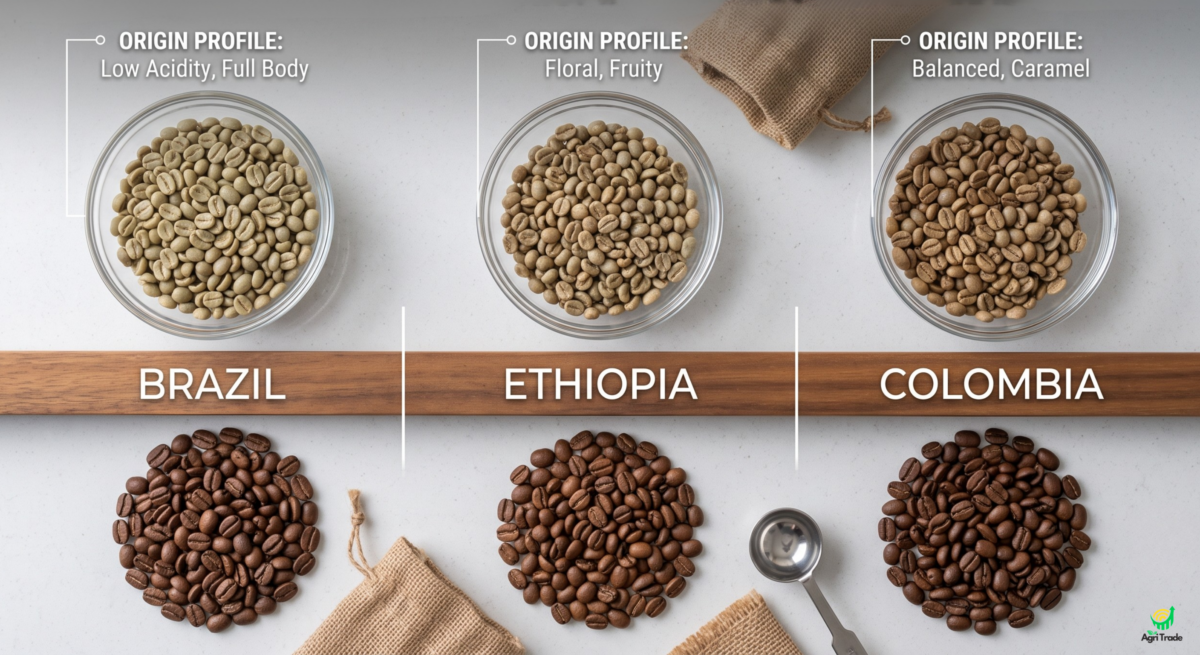
Brazilian arabica, particularly from Minas Gerais, São Paulo, and Espírito Santo, is generally characterized by a low-acidity, full-bodied, nutty and chocolatey cup profile. This makes it a workhorse origin for espresso blends and commercial roasting programs where consistency across large volumes matters more than pronounced varietal character.
Ethiopian coffee, largely still harvested from heirloom varieties across diverse microclimates, tends toward brighter acidity with distinct floral, fruity, or wine-like notes — particularly from washed-process lots from regions like Yirgacheffe and Sidamo. This makes Ethiopian origin a frequent choice for single-origin specialty programs where distinctive character is the selling point.
Colombian arabica sits between these two profiles — typically well-balanced with moderate acidity, notes of caramel and red fruit, and reliable quality consistency driven by the country’s cooperative-based production and quality control infrastructure through the Federación Nacional de Cafeteros.
Supply Reliability: Where Brazil’s Scale Advantage Shows
This is where the comparison becomes most relevant for buyers managing volume, not just flavor. Brazil produces roughly a third of global coffee supply — a scale that Ethiopia and Colombia, while both significant producers, cannot match in absolute volume terms.
This scale advantage translates into practical sourcing benefits: more consistent year-round availability, less exposure to single-farm or single-region crop failure risk, and — critically for buyers scaling beyond boutique volumes — supply chains built for large container-load consistency rather than smaller, more variable lots.
Ethiopian and Colombian supply, while high quality, is more exposed to smallholder-driven production variability, regional weather events affecting a larger share of total national output, and — in Ethiopia’s case specifically — periodic export policy interventions from the Ethiopian Commodity Exchange system.
Price Positioning: Where Each Origin Sits
Brazilian arabica generally trades at a more moderate premium over NY futures compared to specialty-focused origins, reflecting its commercial-grade positioning and larger available volume. Origin differentials for Brazilian coffee do increase for higher-grade, screen 17/18 lots — but even at the premium end, Brazilian pricing typically remains more accessible than comparable-quality Ethiopian or Colombian specialty lots.
Ethiopian specialty lots, particularly from named, traceable micro-regions, command the highest premiums among the three origins — buyers are paying for distinctiveness and traceability as much as cup quality. Colombian coffee typically prices between the two, reflecting its position as a well-regarded but more widely available origin than Ethiopia’s smaller specialty lots.
What This Means for Different Buyer Profiles
Commercial and volume-focused roasters building blends for consistent, large-scale distribution will generally find Brazilian origin offers the best combination of price, supply reliability, and cup consistency for base-blend components.
Specialty roasters building single-origin programs around distinctive flavor stories may prioritize Ethiopian lots despite higher cost and more variable availability, since distinctiveness is central to their value proposition.
Buyers seeking a balance — reasonable cup complexity with more supply reliability than Ethiopia offers — often find Colombian origin fits programs that want more character than a pure commercial blend but without the sourcing complexity of Ethiopian micro-lots.
Many established roasting operations use all three — Brazilian origin as a reliable blend base, with Ethiopian or Colombian lots rotated in for limited-release or single-origin offerings.
Key Specifications: Brazilian Arabica for Buyers Considering Diversification
| Specification | Standard |
|---|---|
| Grade | NY 2/3, NY 3/4 |
| Screen size | 15/16 to 17/18 |
| Moisture | Max 12.5% |
| Processing | Natural, pulped natural, washed |
| Incoterms | FOB Santos or CIF to destination |
| Payment | LC at sight, DLC |
Conclusion
There is no universally “correct” choice between Brazilian, Ethiopian, and Colombian arabica — the right origin depends on whether a buyer’s priority is supply scale and price consistency, distinctive flavor storytelling, or a balance between the two. For buyers building resilient sourcing portfolios, understanding these trade-offs — rather than defaulting to a single origin — tends to produce more resilient long-term procurement strategy.
Considering Brazilian Arabica for Your Roasting Program?
AgriTrade Connect supplies NY 2/3 and NY 3/4 grade Brazilian arabica, screen 15/16 to 17/18, with certificates of analysis available on request.
📧 gabriel.dias@agritradeconnect.com
📱 WhatsApp: +55 17 99735-4202
🌐 agritradeconnect.com
Sources
| Source | Publication | Date |
|---|---|---|
| ICO — International Coffee Organization Origin Reports | International Coffee Organization | 2026 |
| Cecafé — Brazilian Coffee Export Standards | Cecafé | 2026 |